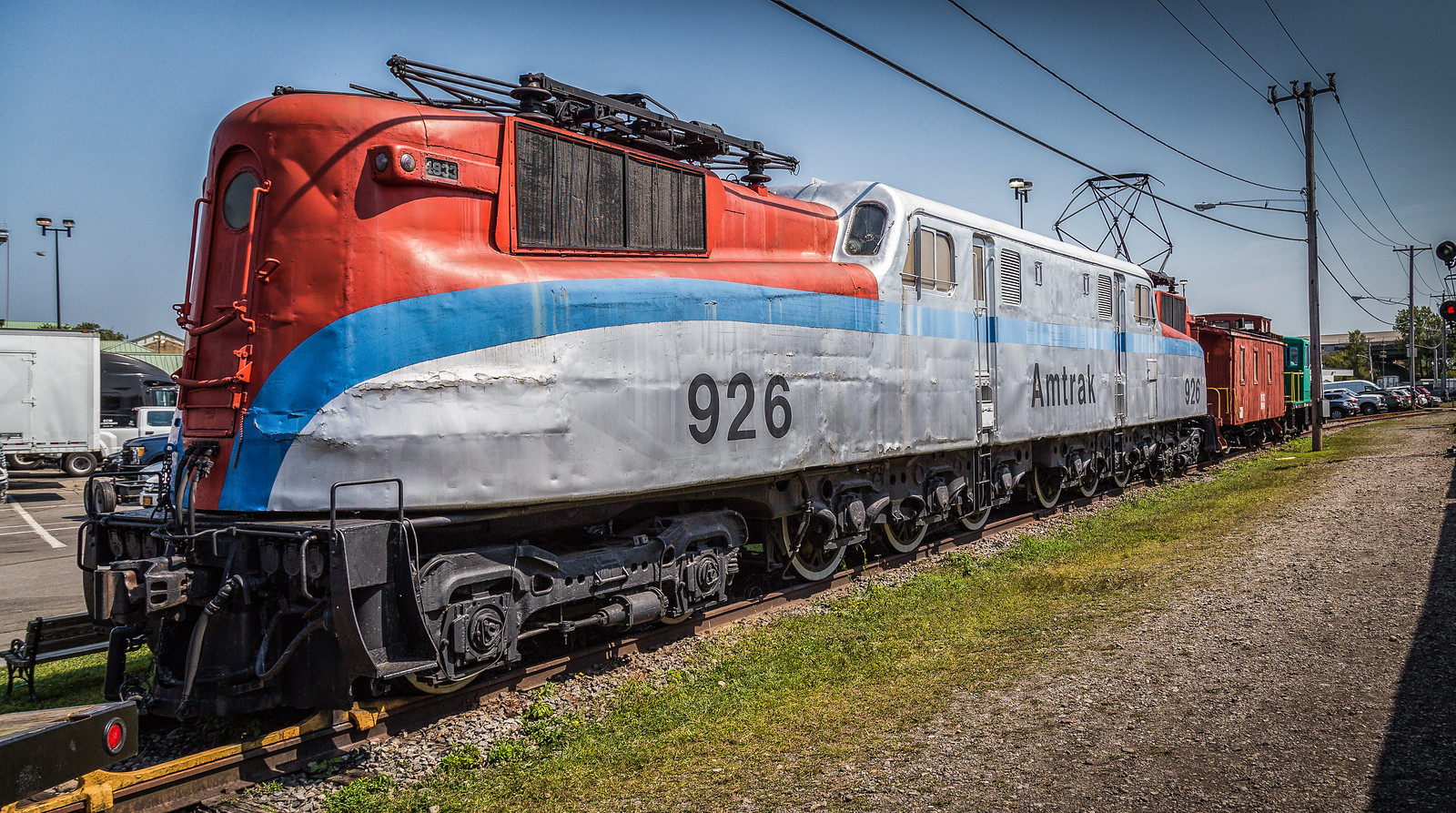
Beginning in the late 1910s, the PRR received the FF1, but decided that it was too slow for passenger trains; it was relegated to heavy freight service. In the mid-1920s, it received the L5 electric, which had a third-rail power supply at the time. When the Pennsylvania built the O1 and the P5, it chose the P5 over the O1 for its ability and power on the rails.
After a grade-crossing accident with the P5a, the cab was moved to the center and was designated P5a (Modified). The P5a’s rigid frame did not track well at high speeds and began developing cracks, leading the PRR to seek an improved design. They found two contacts as early as 1932.
The mechanical design of the GG1 was based largely on the EP3, which the PRR had borrowed from the New York, New Haven & Hartford Railroad to compare it to the P5a. In 1933, the PRR decided to replace its P5a locomotives; it asked General Electric and Westinghouse to design prototype locomotives with a lighter axle load and more power than the P5a, a top speed of at least 100 miles per hour (160 km/h), a streamlined body design, and a single (central) control cab.
Both companies delivered their prototypes to PRR in August 1934. Westinghouse's R1 was essentially "little more than an elongated and more powerful version of the P5a" with an AAR wheel arrangement of 2-D-2. General Electric delivered its GG1.
Both locomotives were tested for ten weeks in regular service between New York and Philadelphia and on a test track in Claymont, Delaware. PRR chose the GG1 because the R1's rigid wheelbase prevented it from negotiating sharp curves and some railroad switches.
On November 10, 1934, the railroad ordered 57 locomotives: 14 assembled by General Electric in Erie, 18 by the PRR's own Altoona Works, and 20 more in Altoona with electrical components from Westinghouse in East Pittsburgh and chassis from the Baldwin Locomotive Works in Eddystone. An additional 81 locomotives were built at Altoona between 1937 and 1943.
On January 28 1935, to mark the completion of electrification of the line from Washington, D.C., to New York City, PRR ran a special train hauled by Pennsylvania Railroad 4800 before it opened the line for revenue service on February 10. It made a round-trip from D.C. to Philadelphia; it completed the return leg in a record 1 hour and 50 minutes.